
Tech and Core Health Analysis
Our Tech & Your Core Score
When we observe patients undergoing Chiropractic care, an incredible array of changes occur at the neurofunctional level.
What is the Central Nervous System?
The most critical system that determines whether your child (and your entire family) is healthy is the Central Nervous System, or just the ‘nervous system’ for short. It’s made up of three divisions, Sensory, Autonomic, and Motor, that work together to coordinate EVERY internal body function with EVERY movement and with EVERY thought, emotion, behavior, and cognitive function. It’s ‘Air Traffic Control’ for the entire human experience!
Dr. Bruce Lipton puts it this way: “The function of the nervous system is to perceive the environment and coordinate the function of all other cells.”
Your nervous system sends signals to communicate with every single one of the billions of cells that make up your body, whether those cells control your heart to beat or your lungs so you can breathe. For us to function at our healthiest, those signals must be travelling between the brain and body at 100%. Each patient undergoes a series of scans so we can track how well their nervous system is coping with the stresses of everyday life. This technology creates accurate, scientifically backed, and objective data that helps give you confidence in the recommendations for your health. The scanning technology uses a combination of tools such as thermal scanning, sEMG, and a Heart Rate Variability, to provide a detailed representation of your nervous system function.

How does it work?
The nervous system is a two-way street. One set of nerves is called ‘sensory’ nerves that send information and report to the brain and brainstem precisely what’s going on inside the body (internal environment) and outside the body (external environment). The other set of nerves is more of what is termed ‘motor control’ nerves that send signals out from the brain and spinal cord and tell the various parts of the body what to do, when to do it, how to do it, etc.
Because neurological communication within the autonomic nervous system has to do this vitally important job for 37.2 million cells in the human body, things need to happen fast and have absolute clear lines of communication. And because a child’s brain (nervous system) doubles in size during its first year of life and continues growing and developing at that rapid pace for the first 3-7 years of life… making sure this system is working at full function is simply the most important exam and assessment any pediatric provider could ever perform for your child.
What Do the INSiGHT Scans look For?
The INSiGHT Scans are about finding, tracking, and understanding if subluxation are present.
And if they are, we need to know two things about them:
- How significant or severe
- Where within the neurospinal system are things primarily located (tracking, targeting)?
What is Subluxation Again?
When too much tension and stress is stuck in one specific area of the neurospinal system, it helps us better understand why certain symptoms and conditions may be present.
- Stuck stress, tension, spasm, etc.
- Lack of balance (more on this later) and coordination
- Disorganization and dysfunction
ALL LEADING TO HEALTH CHALLENGES

Thermal Scanning
Thermal Scanning is used to assess temperature variability along the spine. Temperature is used as an indicator for where stress is building up in your body and how it may be affecting the function of your organs, glands, and blood vessels. Green, blue, and red bars on the top half of the NCM graph indicate the stuck, tension, and sympathetic dominance components of the subluxation. Tons of ‘back and forth’ or ‘tug of war’ type tracking and tracking on the bottom summary graph – this indicates and tension throughout the neurospinal system. The DTG bars along the sides of the summary graph (bottom half) are inside the black lines and blue – this indicates the subluxation and condition are becoming more chronic.
NeuroSpinal EMG
Scans sEMG (surface EMG) is used to assess the function of the muscles directly related to the movement of your spine via the nerves that run through them. This test focuses on assessing the amount of energy needed to maintain your posture in an upright sitting position, as well as how that energy is distributed throughout the spine side to side.
Over time, daily stress can continue to overwork these muscles, causing them to lose their support and mobility. Increased or decreased muscle tone and ineffective muscle control are visible on these scan results. Muscle fatigue and poor energy distribution are signs of a person’s entire health being under stress.
Neurological and tone challenges are a big deal, as motor function and development determine brain function and development. That means – if the EMG scan detects patterns of stuck tension and imbalance, the brain is almost certainly stuck in sympathetic (fight or flight) tone and also struggling with an imbalance between its core functions.

The most exciting thing about Pediatric Chiropractic is that we can see changes in a child’s EMG Scans quickly because their nervous system is still learning to grow and adapt at such a fast pace. Their brains and bodies are growing and developing rapidly; it’s quite incredible. But that also means that when subluxation gets into the neuromuscular system (as shown on EMG), it can wreak havoc and alter their development for years to come.
Diving a bit deeper into this particular scan, our INSiGHT EMG Scans also use a 3-step scoring system that allows us to really understand what’s going on with that child’s neuromotor system and, thus, overall brain and neurodevelopment.
Here are the 3 scores you’ll see on your child’s EMG Scan and a quick explanation of what they mean, and then we’ve provided some examples of EMG scans as well:
Total Energy Score – this score tends to go way up in a child who’s wound up and stuck in sympathetic mode, and therefore a high score here is most often seen with our ‘Raging Bull’ cases.
Pattern Score – this is a significant score to the overall neurological tone.
Symmetry Score – this score measures the balance between the right and left sides of the neurospinal system, which is crucial to be then sure that there is balance in overall brain function and coordination Heart Rate Variability (HRV) Scans.
Heart Rate Variability
These scans are beneficial at getting a broader picture of a patient’s neurological health, telling us whether their autonomic nervous system is healthy, balanced, and fully charged… or stressed out, imbalanced, and worn out. The keyword here is ‘variability’ because that is indeed the number one marker of good neurological health: the ability to be adaptable and resilient.
Adaptability is key to good health, to be able to overcome normal challenges in our everyday lives when we experience health challenges on our system. The vast majority of HRV scans in our office look like the sample scan below for kids and adults alike. The white dot to the lower left as it indicates two very common findings that are the result of subluxation and dysautonomia:
Shifted left – meaning the patient is stuck predominantly in sympathetic fight-or-flight mode and/or has an exhausted parasympathetic nervous system and vagal tone issues
Shifted low – indicating the patient has lower ‘reserve capacity’ and adaptability, or “low energy”

Putting It All Together
The nervous system is involved in all disease states and is inherent in promoting a desirable state of wellness and performance. By producing hormones such as adrenaline and glucocorticoids, the sympathetic system stimulates a fight-flight response.
Not all stressors carry life or death consequences. A ringing phone, a crying baby, walking outside in the cold, driving in traffic, or even going to sleep are situations that require your body to adapt in an appropriate manner.
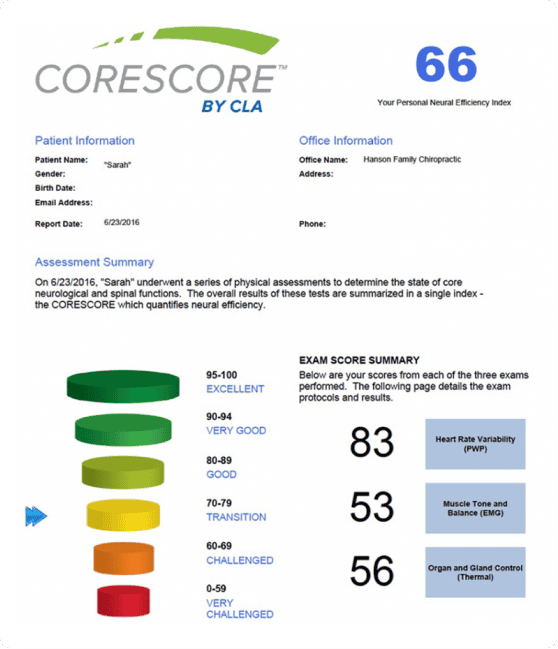
All of these situations require a change from your nervous system, and how efficiently and to what degree the changes take place is a reflection of how healthy you are. You have an incredible capacity for self-healing and self-regulation, but repeated, chronic, or acute stress can overwhelm your system. Together, the three tools formulate your COREscore. The COREscore rates the overall stress on your nervous system with a number of 0-100.
When we observe patients undergoing Chiropractic care, an incredible array of changes occur at the neurofunctional level.
The overall balance and capacity of their autonomic nervous system improves.
They spend much less motor-neural activity to maintain their postures.
They move with greater freedom and efficiency.
They experience EASE not dis-EASE!